
Case study · IoT · Sports technology
ArcVector: a connected training ball, designed from firmware to cloud
ArcVector is a baseball training platform. A smart ball records its own motion and impacts, then downloads them at a charging dock, so players and coaches can review every session in an app.
The challenge
The first concept assumed the ball could stream live data to a gateway during play. Calculation and testing showed that is unreliable: a thrown or hit ball leaves Bluetooth range, and spin changes the antenna orientation many times a second. A continuous high-rate recording would also be too large to store and download.
The team needed an architecture that works in the real world, protects the player data, and does not claim more accuracy than inertial sensors can deliver.
Our approach
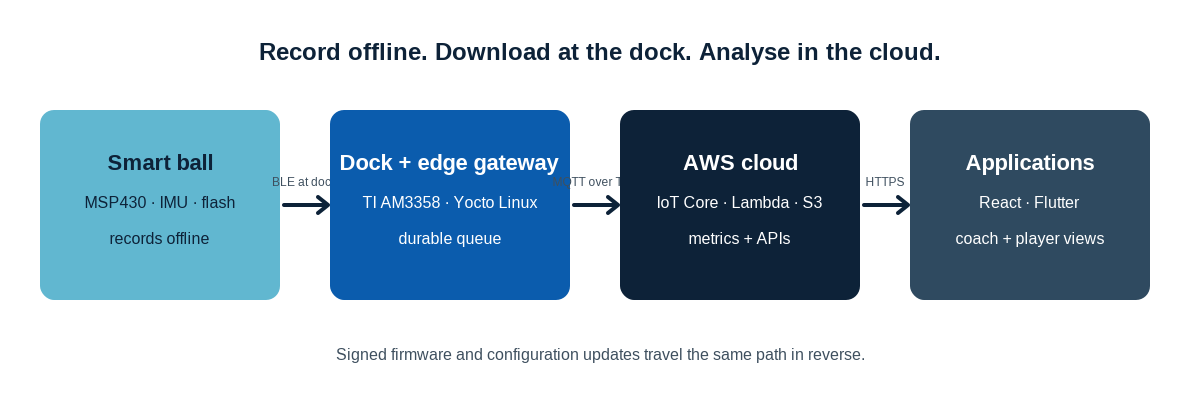
We replaced live streaming with record offline, download at the dock. The ball stores every throw and hit in on-board flash. When it is placed on its dock, it charges and automatically downloads the session to an edge gateway, which verifies the data and forwards it to the cloud.
Key engineering decisions
- Adaptive sampling. A low rate in flight and high-rate bursts at impacts cuts a recorded cycle from roughly 180 kB (continuous 1 kHz) to about 65 kB.
- Resumable, checksummed download. The ball sends numbered chunks with a CRC on each. If the link drops or the ball is lifted, the transfer resumes from the last acknowledged chunk, and the ball erases data only after the gateway confirms it is safely stored.
- Found the real bottleneck. Analysis showed the limit is the UART link between the MSP430 and the Bluetooth module and the Bluetooth version, not the sensors, flash or cloud. The design raises the baud rate where both parts allow it and uses BLE 5 data length extension, which lifts packets from 20 to 244 bytes.
- Two measurement layers. The ball measures its own motion. An external calibrated camera or radar measures absolute position. Keeping them separate prevents drift-prone inertial estimates from being shown as a precise trajectory, and the apps label data quality accordingly.
- Built to survive impact. Potted capsule, small light components, welded battery tabs, flash writes from RAM after impact, and a CRC on every record.
- Security from the start. A unique certificate per gateway with the key in a secure element, LE Secure Connections for ball pairing, mutual TLS to the cloud, KMS-encrypted storage, tenant-scoped access with Cognito, signed firmware with rollback, and consent handling for players under the age of majority.
What we delivered
- A 27-page solution design covering the ball, firmware requirements, dock and gateway, BLE download protocol, cloud platform, analytics, application design, security and privacy.
- Data-budget calculations and proposed non-functional targets, including download-time targets in place of latency.
- A five-phase delivery plan: feasibility, prototype, reference validation, application build, and pilot and hardening, each with exit criteria and a risk register.
Status and honesty about numbers
This engagement produced a proposed design. Rates, times and capacities quoted above are calculated estimates that the plan requires to be confirmed on a real ball in the feasibility and prototype phases. We state this clearly because overstated accuracy would cost a coaching product its users' trust.